Blog
Why Finance Leaders in India need to Rethink NetSuite Legacy Tax
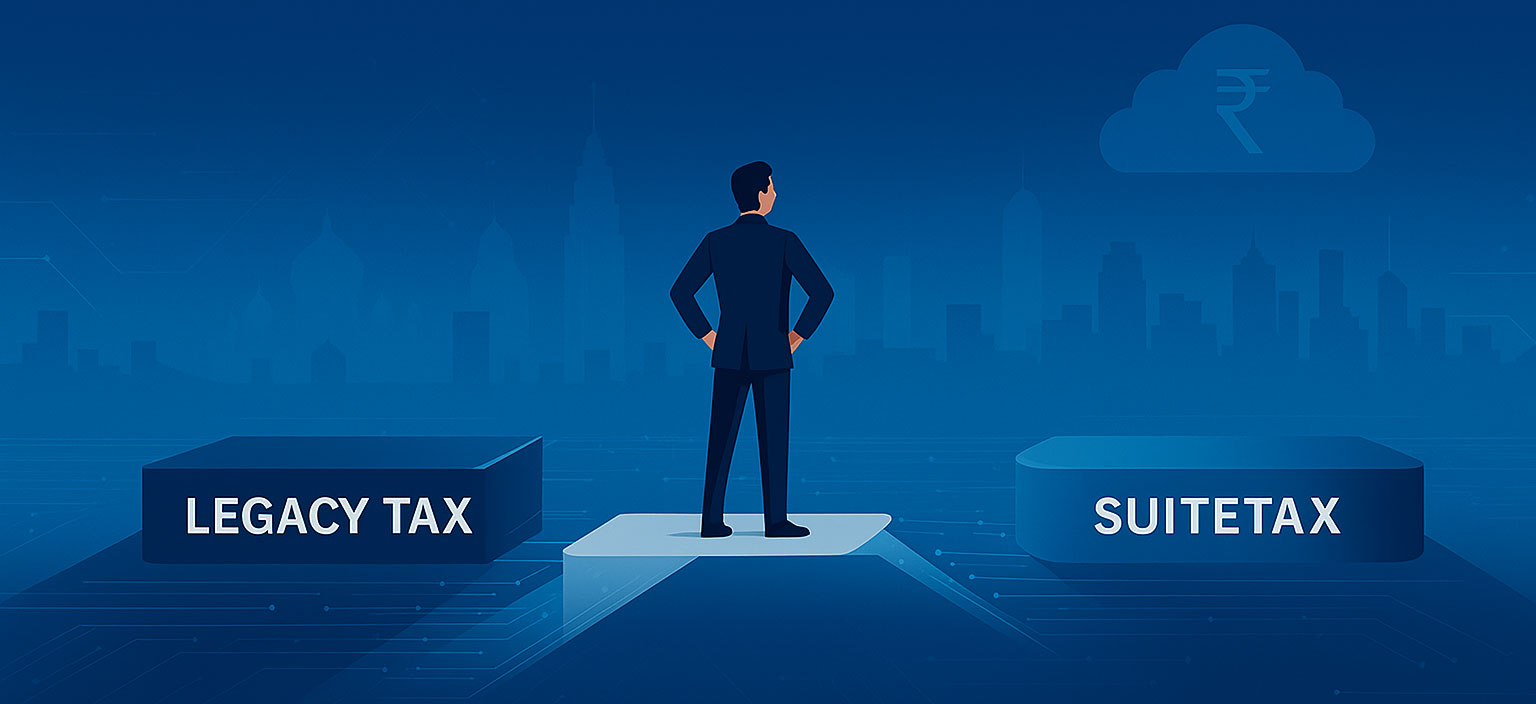
If you've ever tried balancing on two boats at once, you know it's only a matter of time before you fall into the water. That's what many global companies are facing today running NetSuite Legacy Tax for their global operations while depending on a separate local accounting tool to meet India's tax rules. On paper, it works. In practice, it's inefficient, error-prone and unsustainable.
Finance and tax teams spend unnecessary time reconciling data between two systems, worrying about compliance and firefighting integration issues. Meanwhile, the business risks falling behind on India's fast changing tax environment.
Why Legacy Tax Can’t Keep Up
The hard truth? NetSuite Legacy Tax was never built for India’s complexity. Goods and Services Tax (GST), multiple tax types (CGST, SGST, IGST), cess, TDS, TCS and mandatory E-invoicing Legacy Tax struggles to handle these requirements. It doesn’t update automatically when regulations change and it lacks essential features like E-invoicing and E-Way bills. Add to that the fact that Oracle NetSuite has shifted its focus entirely to SuiteTax and it’s clear: Legacy Tax is yesterday’s engine trying to run today’s race.
Some companies consider customizing Legacy Tax to bridge the gaps. But that’s a risky move-Legacy Tax is on a deprecated architecture, meaning no new updates, no future compliance fixes and limited support. In short, investing in patchwork customizations is like repairing a sinking ship instead of moving to a sturdier vessel.
How SuiteTax Solves the Problem
SuiteTax, on the other hand, was designed with flexibility and compliance in mind. It adapts quickly to new mandates, automates complex calculations and connects seamlessly to India’s regulatory systems. More importantly, with Oracle’s data centers in Mumbai and Hyderabad, businesses can keep their financial records within Indian borders, meeting the Ministry of Corporate Affairs’ rules on data residency and daily backups. Compliance isn’t a headache it’s built into the system.
Migrate to SuiteTax from LegacyTax Engine
The question isn’t whether companies should move to SuiteTax, but how to do it without disrupting global operations. To make that transition seamless, BONbLOC helps enterprises migrate smoothly from legacy tax engines to Oracle SuiteTax. Before making the switch, several key factors must be evaluated to enable a seamless transition across global operations:
- Number of Subsidiaries and Countries Where you Operate.
- Number of Nexuses.
- Number of Entities .
- Number of items.
- Complexity of Tax Requirements.
- Existing Customizations or Scripting that Involve any Tax-Related Records.
- Internal or Third-Party Implementation Resources.
Customers migrating from legacy tax may also need to review their current customizations or scripts that interact with tax-related records.
Because of the perceived risks involved, many organizations initially choose to run both systems in parallel before fully switching over.
NetSuite all the way
Since users are already familiar with NetSuite, we recommend the following approach to support India operations effectively:
- Procure a stand-alone instance of NetSuite to meet the India operations requirements.
- Connect it with the global instance to maintain unified reporting.
We help businesses take a 3 phased, low-risk approach:
- Phase 1 - Start with scheduled syncs for master data and summarized transactions. This keeps global reporting intact while India runs on SuiteTax.
- Phase 2 - Monitor performance closely, fine-tuning scripts and ensuring compliance stability.
- Phase 3 - As transaction volumes grow, migrate to middleware for real-time integration, automation and scale.
Think of it like building a new highway alongside your current road. You start with a simple connection, so operations continue smoothly. As traffic grows, you add more lanes, bring in automation and eventually upgrade to a full-scale integration that can handle real-time flows without bottlenecks.
This way, companies get the best of both worlds: compliance in India today and a scalable foundation for tomorrow. Instead of patching an old system, finance leaders can focus on what really matters-accuracy, efficiency and confident decision-making.
The Takeaway for Financial Leaders
Legacy Tax might still be running, but it’s slowing you down. SuiteTax is not just an upgrade-it’s a strategic investment in future-proofing your operations. By rejecting stopgap customizations and adopting a phased transition plan, finance leaders can ensure compliance today while building a stronger foundation for growth tomorrow.
Keywords for SEO: NetSuite SuiteTax, NetSuite India compliance, GST automation, Indian tax compliance, NetSuite E-invoicing, NetSuite Legacy Tax challenges, NetSuite data residency, BONbLOC NetSuite solutions, MCA Compliance
Categories
- Bonbloc AI Lights Up Chepauk: Stadium Branding Experience Across All CSK Home Matches
- Bonbloc AI Goes Big: High-Impact OOH Branding
- BONbLOC Partners with Chennai Super Kings as Official AI Partner
- AI and the Future of CFO Leadership: Resilience, Risk & Transformation
- The New CFO Mandate: Leading Digital Transformation with ERP and AI
- Why Finance Leaders in India need to Rethink NetSuite Legacy Tax